
Types of Breast Conditions and How to Treat Them
Posted on December 10, 2025Key Takeaways
-
Many women experience variations in breast shape, size, and positioning, which are completely normal.
-
Common breast conditions include: unbalanced (asymmetrical) breasts, unusually large breasts, breast ptosis (sagging), and tubular (tuberous) breasts.
-
Treatments range from surgical interventions like breast lifts, reductions, augmentation, and reconstruction to non-surgical solutions for mild concerns.
-
Understanding your breast type helps guide personalized treatment plans to restore symmetry, proportion, and confidence.
1. Unbalanced (Asymmetrical) Breasts
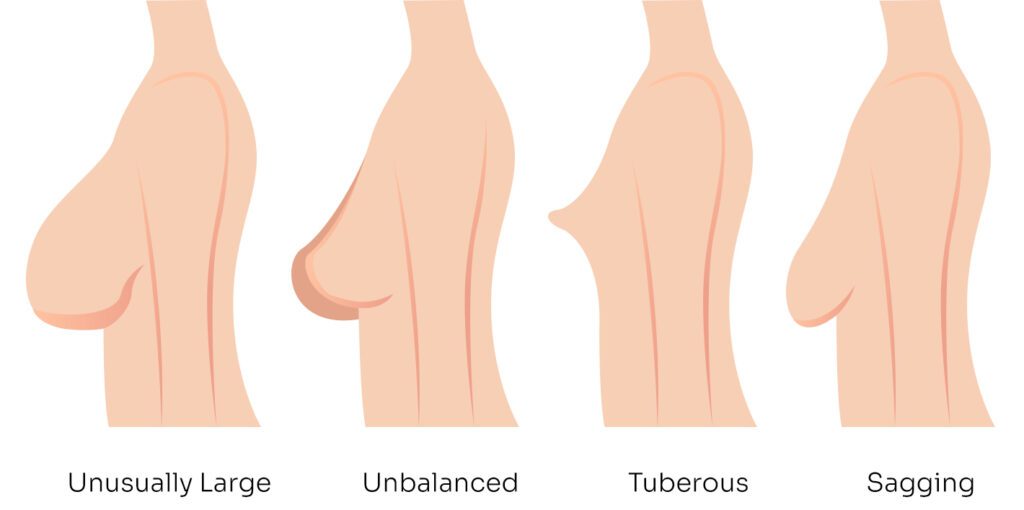 Unbalanced breasts occur when one breast differs in size, shape, or nipple position compared to the other. Minor asymmetry is normal, but noticeable differences can impact appearance and self-confidence.
Causes
-
Natural development during puberty
-
Hormonal changes
-
Weight fluctuations or pregnancy
-
Previous surgery or trauma
Treatment Options
-
Breast augmentation: Using implants to enlarge the smaller breast for symmetry
-
Breast reduction: Reducing the larger breast to match the smaller one
-
Breast lift (mastopexy): Adjusting nipple position or shape for balance
-
Fat transfer: Adding volume to the smaller breast using your own body fat
2. Unusually Large Breasts (Macromastia)
Unusually large breasts can cause physical discomfort, including back, neck, or shoulder pain, as well as self-consciousness.
Causes
-
Genetics and family history
-
Hormonal changes during puberty, pregnancy, or weight gain
Treatment Options
-
Breast reduction surgery: Removes excess breast tissue and skin, alleviating discomfort and improving proportion
-
Liposuction-assisted reduction: For select patients with moderate excess tissue
-
Post-surgical support garments and proper posture guidance aid long-term results
3. Breast Ptosis (Sagging Breasts)
Breast ptosis, commonly known as sagging, occurs when the breast loses firmness and the nipple falls below the breast crease.
Causes
-
Aging and natural collagen loss
-
Pregnancy and breastfeeding
-
Weight fluctuations
-
Gravity and lifestyle factors
Treatment Options
-
Breast lift (mastopexy): Removes excess skin, lifts breast tissue, and repositions the nipple
-
Breast lift with implants: Combines lifting and volume restoration for fuller, youthful shape
-
Fat grafting: Adds subtle volume, particularly for mild sagging
4. Tubular (Tuberous) Breasts
Tubular breasts are characterized by a narrow base, elongated shape, and enlarged or puffy areolas. This condition can occur in one or both breasts and may affect self-esteem.
Causes
-
Congenital (present at birth) due to abnormal breast development
-
Often more noticeable during puberty
Treatment Options
-
Surgical correction: Reshaping the breast base and creating a more rounded contour
-
Breast augmentation: Adds volume and symmetry
-
Areola reduction: Corrects enlarged or puffy areolas for a natural appearance
-
Combination procedures: Many patients benefit from a lift or implant plus reshaping for optimal results
Choosing the Right Treatment
Each breast condition is unique. Key factors in deciding treatment include:
-
Degree of asymmetry, sagging, or tuberous shape
-
Breast size and volume
-
Skin elasticity and tissue quality
-
Patient goals and lifestyle considerations
A board-certified plastic surgeon can evaluate your individual anatomy and recommend a tailored plan to achieve natural, symmetrical, and confident results.
Frequently Asked Questions
Are breast asymmetries common?
Yes. Minor differences are normal, but surgical options can correct noticeable imbalance.
Does breast reduction affect breastfeeding?
Many women can still breastfeed, though it depends on surgical technique and tissue removal.
Can sagging be fixed without surgery?
Non-surgical skin tightening may help mild sagging, but moderate to severe ptosis generally requires a breast lift.
Are tubular breasts only cosmetic?
Yes, tuberous breast correction is primarily cosmetic, though it can greatly improve confidence and symmetry.
For More Information on the Treatments and Procedures offered, contact award-winning Board Certified Plastic Surgeon Dr. Thomas Fiala at Fiala Aesthetics in Greater Orlando to Schedule Your Consultation:


Voted the #1 Best Plastic Surgeon in Orlando, Florida by the readers of Orlando Magazine.